
A Guide to the Next Competitive Advantage
Artificial intelligence has moved beyond the realm of experimentation and become a business reality. Whether leadership teams have formally adopted AI or not, employees use it to research information, draft communications, summarize data, and complete tasks faster than ever before. The question isn’t whether AI fits in your organization; it's whether your organization is prepared to use it strategically, securely, and effectively.
For business leaders, understanding AI is about recognizing how this technology will reshape productivity, decision-making, workforce structure, and competitive advantage. Organizations that embrace AI with a clear strategy will multiply efficiency and uncover new opportunities for business growth. Those that ignore AI’s benefits risk falling behind as competitors accelerate in an increasingly competitive world.
Understanding the Evolution of AI
To understand where business is headed, it is helpful to look at how artificial intelligence evolved into its current state.
Artificial intelligence broadly refers to computers performing tasks that traditionally require human intelligence. For decades, this was driven primarily by traditional machine learning (ML), where algorithms were trained on historical data to recognize patterns and predict outcomes. In business environments, traditional ML quietly powered essential tools such as email spam filters, credit card fraud detection, supply chain forecasting, and predictive equipment maintenance.
More recently, generative AI shifted the landscape from pattern recognition to content creation. Unlike classical machine learning that classifies existing data, generative AI uses deep neural networks trained on massive sets of text, code, and imagery to understand complex language patterns. When given a prompt, it predicts and synthesizes the most relevant words, code snippets, or ideas to produce brand-new, human-like output. Popular platforms such as ChatGPT, Claude, Gemini, and Microsoft Copilot have brought these capabilities directly into daily business operations.
The next phase is already emerging: Agentic AI.
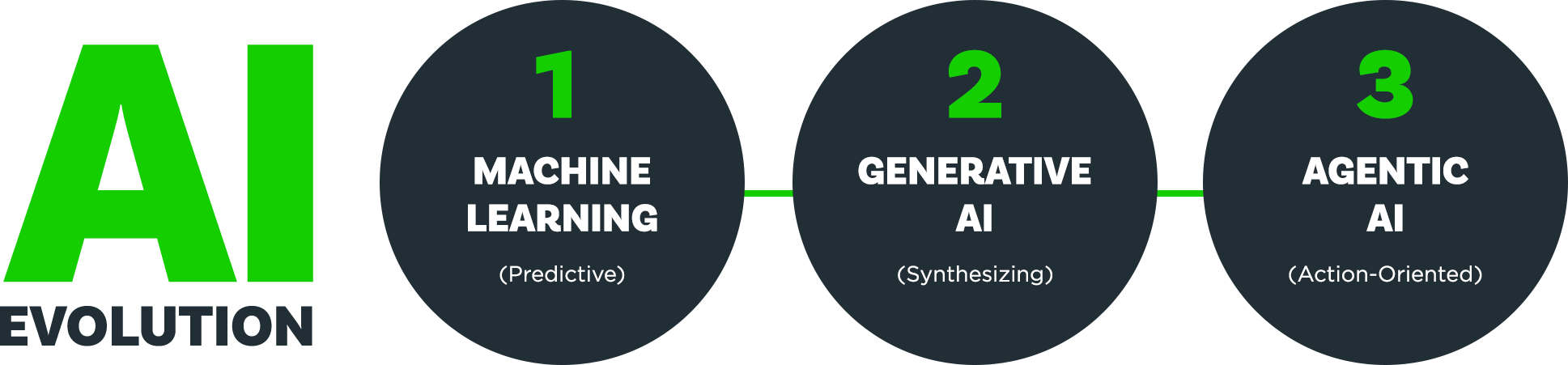
Unlike generative AI, which simply responds to prompts, agentic AI takes proactive action. It analyzes information, executes multi-step workflows, monitors systems, interacts with internal applications, and completes complex tasks on behalf of users. Rather than simply helping employees write faster, agents become active participants in the business process.
The implications are significant. Organizations will increasingly manage a digital workforce alongside their human one, creating new opportunities to scale operations, improve efficiency, and rethink traditional operational structures.
Your Employees Are Already Using AI
Many leaders continue to debate whether they should allow AI in the workplace. In reality, that decision has already been made.
Across every industry, employees are actively using AI to:
Draft emails, client updates, and internal memos
Conduct market and industry research
Summarize lengthy meetings and transcripts
Build reports, proposals, and presentations
Analyze operational spreadsheets and raw data
Accelerate daily task execution
In many cases, they are doing so without formal approval, governance, or IT oversight. Some use free public tools, while others pay for individual subscriptions out of pocket.
This creates both immediate opportunity and serious risk.
The opportunity is substantial productivity improvement, turning tasks that once consumed hours into work finished in minutes. The risk: sensitive company data, intellectual property, or customer records may enter public AI models without leadership visibility or security safeguards.
Ignoring AI does not prevent its use. It simply strips the organization of its ability to manage it responsibly.
The Future Workforce: Humans and AI Working Together
One of the biggest misconceptions about AI is that it exists to replace human workers. The strongest near-term value comes from augmenting employees and freeing them from repetitive, low-value administrative burdens.
AI agents can serve as digital team members assisting with critical operational functions:
Customer Support: Resolving tier-one tickets and routing complex requests instantly.
Business Reporting: Pulling weekly KPIs and operational updates automatically.
Knowledge Management: Organizing institutional processes and making internal documentation instantly searchable.
Sales Enablement: Preparing account briefs, call summaries, and customized outreach collateral.
Operational Workflows: Bridging repetitive data handoffs between disconnected systems.
Executive Insights: Surfacing operational trends before issues escalate.
As these systems mature, organizations will deploy networks of specialized agents working alongside internal teams. What began as a personal productivity shortcut is quickly evolving into an enterprise-wide digital workforce.
However, deploying an AI agent is only half the equation. Before any intelligent system can deliver reliable business value, it requires a secure, unified foundation of company data.
Ready to Build an AI Strategy That Empowers Your Team?
Whether you need to establish clear AI governance policies, protect sensitive company data from shadow AI risks, or prepare your workforce for digital agent integration, Telcion provides the expertise and engineering leadership to guide you forward.
Take the first step toward a secure, productive AI strategy today.