
Cisco's Biggest On-Premises Move in Years Lets You Modernize Without Migrating

If you run Cisco Unified Communications Manager (UCM), you have heard the same message for years now:
“Innovation is in the cloud, and the way to access it is to migrate.”
Every time someone asks you why UCM can't transcribe or summarize a call, you have to defend your use of the Cisco platform.
At WebexOne 2026, I heard Cisco say something different. Cloud Intelligence for UCM is a single add-on license that brings Webex Calling features, Cisco AI, cloud call recording, E911, and cloud-based administration to your existing on-premises UCM. Phones stay registered to UCM for call control. Nothing migrates unless you are ready to move a user or a group of users to the cloud.
It is the most significant investment Cisco has made in on-premises UCM in years, and it signals that Cisco is building the future of its calling platform around UCM, not away from it. UCM customers have seen plenty of features launch with a "Webex Calling only" footnote.
Three things make this announcement different.
Cisco changed its framing. The message at WebexOne was that hybrid is the future of calling and that businesses need a modernization strategy, not a migration timeline. Cisco cited Frost and Sullivan research showing most organizations plan to keep premises-based telephony through 2029.
Cisco changed its framing. Alongside Cloud Intelligence, Cisco is adding features in UCM 15, working on UCM 16, building support for VMware VVF and VCF 9.x, investing in alternate hypervisors like Cisco NFVIS-for-UC and Nutanix AHV, and preparing the M8 generation of Cisco server hardware.
Cisco changed its framing. Call recording, E911, CDR analytics, spam and fraud protection, and provisioning tools are typically licensed by most UCM shops from three or four vendors. Cloud Intelligence consolidates them into a single add-on license from Cisco.
Cisco is making a real bet on UCM, and it's betting on the customers who stay on the platform.
What is Cloud Intelligence for UCM?
A single add-on license layered on your existing Cisco Collaboration Flex subscription. It uses Cloud-Connected UC, now expanded to cover Expressway and CUBE, to connect your on-premises environment to the Webex cloud.
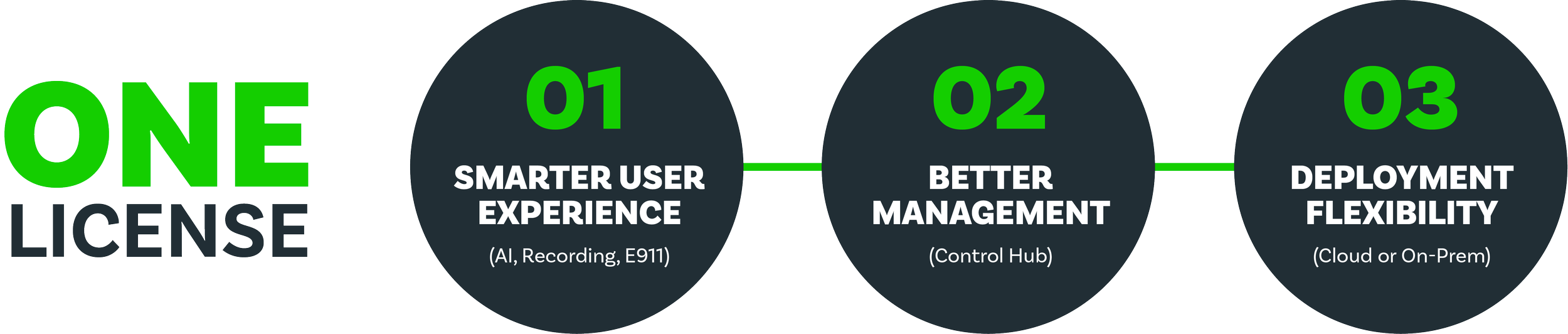
It unlocks three things:
A smarter user experience. Cisco AI Assistant, the full Webex Calling feature set in the Webex app, cloud call recording, E911, and spam and fraud protection, all on top of UCM call control.
Better management. Collaboration Control Hub becomes the operations and provisioning console for your on-premises environment, with AI anomaly detection, centralized alerting, and natural language administration.
Deployment flexibility. Cloud PSTN for UCM is now an option for on-premises deployments, and Cisco is enabling users to move between UCM and Webex Calling in either direction without a license change.
Every one of these is designed to be adopted while UCM stays exactly where it is. Cisco wants customers to modernize on their own terms and timeline.
Modernize the user experience without migrating
Enterprises have made significant investments in the Cisco UCM platform, so Cisco is ensuring that investment continues to pay off. None of these new features requires moving a user off of UCM.
Cisco AI Assistant for Calling: Live transcription, call summaries, action items, and topic analysis, with searchable transcripts after the call and real-time translation through Translator Agent. These were multi-tenant only until now. An open MCP integration lets you connect the output to your own platforms.
Cloud call recording: Built-in bridge technology records UCM calls to the cloud. Recordings live in Control Hub under your compliance and governance rules, can be pulled by API, feed into Webex Compliance Hub for legal hold and discovery, and get the same AI transcription and summaries.
Full Webex Calling features: Licensed users get Webex Calling Professional features in the Webex app while their phones stay on UCM. Cisco shipped more than 150 new Webex Calling capabilities in the past year, and this is how UCM users get them.
High-trust calling: STIR/SHAKEN call rating and blocking powered by Mutare and SecureLogix, plus admin blocking by number pattern or country code.
E911: A base RedSky E911 endpoint license is included. Use RedSky location services or Cisco's own LIS in Control Hub to manage locations and devices for your UCM endpoints.
Coming in the future: Pindrop integration for deepfake detection and voice fingerprint analysis, and the AI experience on Cisco 9800 series phones.
Cisco also announced add-ons that can integrate with on-premises UCM and do not require Cloud Intelligence: AI Receptionist as a 24/7 virtual front desk, Customer Assist as a light contact center with sentiment analysis and suggested responses, and a new Cisco Attendant Console for UCM.
Modernize administration without migrating
If the user features are the headline, the management features are the daily payoff. Anyone who has chased a call failure across RTMT, CDR exports, and a SIP trace at 2 a.m. will appreciate this. Your clusters stay on-premises. What changes is where you manage them and how much the platform does for you.
Real-Time AI Insights: Collaboration Control Hub learns your environment's normal business hours, call volumes, and failure trends. When deviations occur, it flags anomalies, identifies the likely root cause, and recommends next steps. The shift is from reactive, post-incident troubleshooting to preventive monitoring.
Alerting that replaces RTMT email overload: One alert view across UCM, Unity Connection, IM and Presence, Expressway, and CUBE, with AI-derived rules, delivered to the Webex app, email, or webhooks.
Natural language provisioning: Collaboration Control Hub becomes the provisioning engine for UCM. Type "deploy 20 new UCM users" or "move user X to multi-tenant including 3 devices" instead of clicking through a dozen configuration screens.
AI Canvas: Cisco's new cross-platform AI layer ingests data from UCM, ThousandEyes, Catalyst Center, Meraki, Splunk, Duo, and SD-WAN to enable plain-language questions against the data. AI Canvas will generate a SIP ladder diagram, a likely root cause, and recommended next steps. It also builds custom dashboards and reports. AI Canvas is not required for the base analytics and alerting.
Coming in the future: Automated upgrade assistance and certificate management for UCM, Unity Connection, and CUBE.
Your clusters stay ON-premises. What changes is where you manage them and how much the platform does for you.
Move when you want, in either direction
"Modernize without migrating" does not mean "never migrate." It means you can control migration to the cloud, one site or one user at a time, and you can reverse it.
Cloud PSTN for UCM: Cisco Calling Plan will extend to on-prem UCM on a metered, pay-per-minute basis. You pay for numbers and minutes, with no flat per-phone charge, and manage it all in Collaboration Control Hub. Or connect your trusted Cloud Connected PSTN partner through a route list.
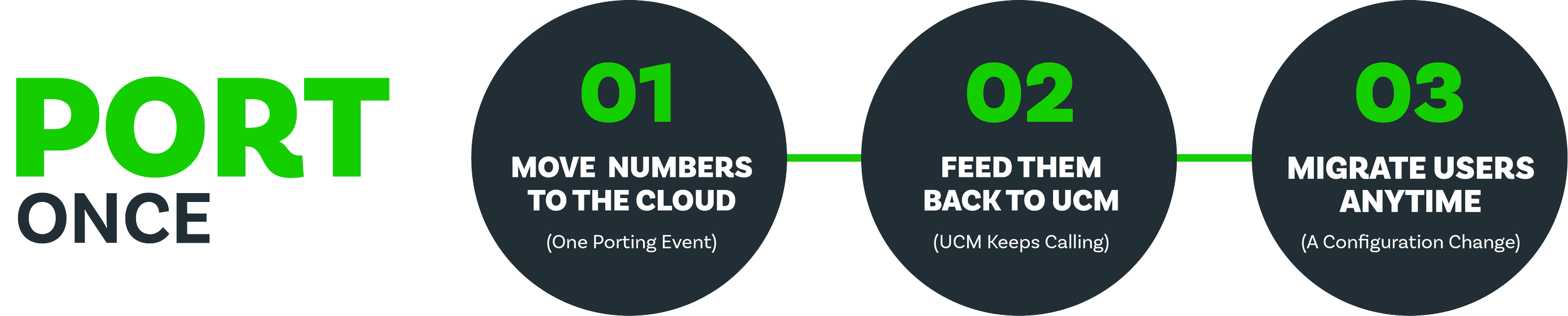
Port once: Cisco's recommended approach is a single porting event. You can move your numbers to the cloud early, feed them back to UCM, and make user migrations a configuration change rather than a lengthy carrier project.
Bidirectional Migrations: Bidirectional migration moves users, devices, or entire locations between UCM and Webex Calling without a license change. Adopt the Webex cloud by region, site, or user, and keep users on UCM where regulatory or survivability requirements demand it.
UCM has earned its reputation. It is extraordinarily reliable, it handles dial plans and integrations that cloud-only platforms still struggle with, and it keeps working when the internet does not. Cloud Intelligence adds the cloud on top and leaves you in control of what moves, when, and whether it moves at all.
The Bottom Line
If your UCM environment has felt frozen in time, this is the clearest signal yet that it does not have to remain that way. The features your leadership keeps asking about are available on the platform you already trust. Cisco is investing in it for the long haul, and none of it requires a migration.
Cloud Intelligence adds the cloud on top and leaves you in control of what moves, when, and whether it moves at all.
Telcion has designed, deployed, and supported Cisco UCM for over 20 years. When technology shifts, having the right partner ensures your organization is Always ON: ON demand when you are ready to modernize, ON the leading edge of new AI capabilities, and ON guard to keep your on-premises infrastructure secure and reliable.
Ready to Modernize on Your Terms?
If you want to talk through what Cloud Intelligence means for your environment, reach out to your Telcion account team today.
Learn more: