
From Coast Guard to vCIO: Craig Urrizola Interview with Lance Reid
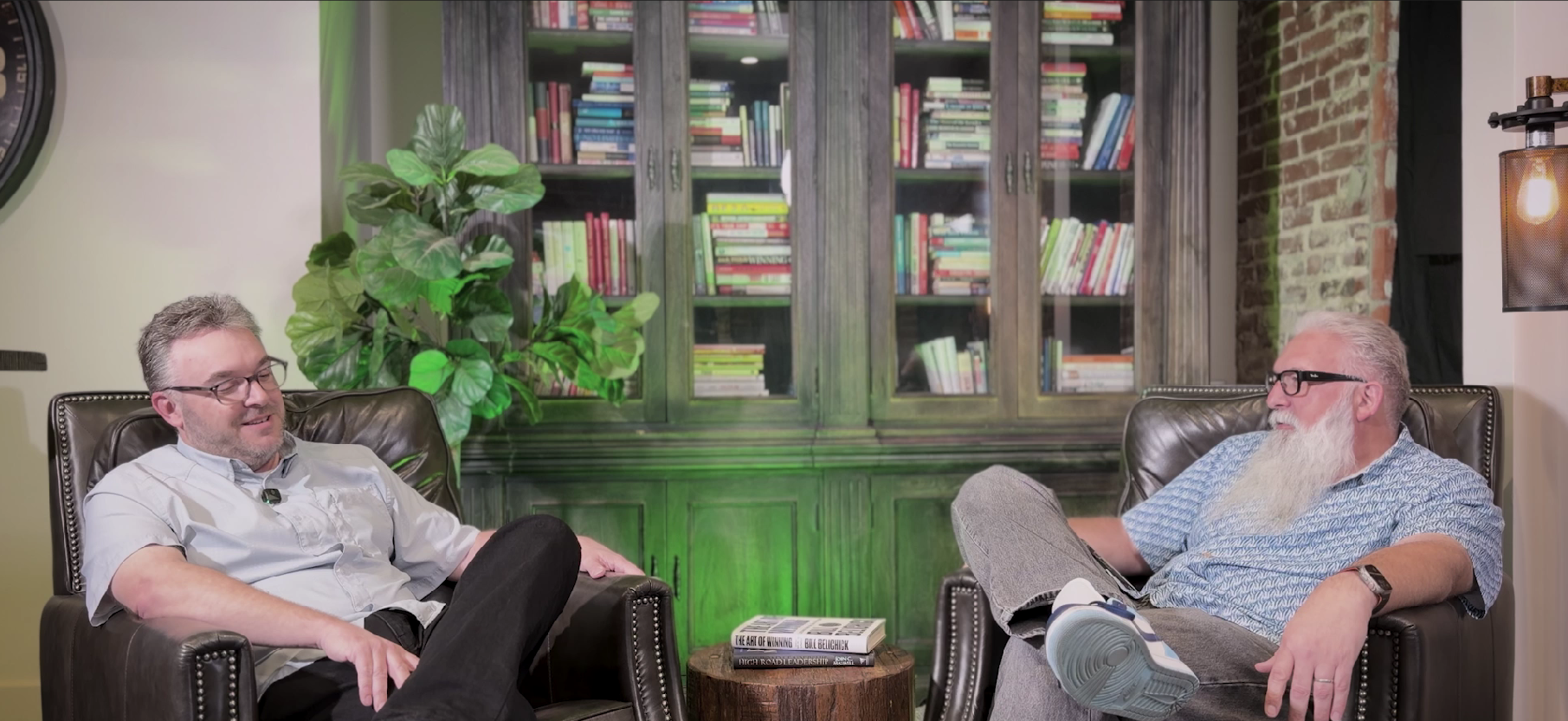
Our CEO Lance Reid sat down with Craig Urrizola, VP of Consulting and Engineering, to discuss Craig’s history in the IT industry and the many experiences that he’s accumulated that help him be a better vCIO. In their conversation, Lance and Craig discuss:
How Craig helped lead Saladino’s IT team taking it from a 100-million-dollar business to a 750-million-dollar business in 20 years, then through a successful acquisition by US Foods,
The different techniques Craig used to make the business more efficient and profitable, including knowing when to outsource and when to keep projects in house.
Why Craig has returned to consulting and why he’s excited to be offering vCIO services.
An interview video will be coming soon!
Full transcript below:
Lance: Thanks for taking some time out here to talk over a few things. I thought I would start out by giving me a little history about your IT career. I mean you’ve had a long career at this point but how did you get started? What got you into IT? Tell me a little bit of the background.
Craig: When I got out of the Coast Guard, I realized that’s not the life I wanted to live. Graduating high school, I ended up getting a scholarship to go to college and ended up turning it down to go to the Coast Guard. It was a computer science scholarship. So, I came back and went the Microsoft/MCSE route and got into consulting and moved up from there. As you know we ended up working for the same consulting firm for a period of time and we got to do some fun things. But then it was time to go. I got into more of the citric and terminal server projects and did large scale hospital migrations, investment firms, nationwide and worldwide rollouts for Citrix back in those days. And then, the kids were small and tired of traveling, so I ended up coming back and working for Saladino’s. I was IT guy number one and moved my way up. I went back to college and graduated and ended up as the CIO, did that for 23 years before the acquisition from US Foods.
Lance: And at some point, you went back and worked on your Masters, right?
Craig: So, when I first started at Saladino’s I finished my bachelor’s because I had been traveling and had time to do it. And then I got my Masters. When I became CIO [afterwards], I realized very quickly that I need a business background more than an IT one. So, I went back and got an MBA at Fresno State. Let it through the acquisition, finished that off with US Foods, and successfully got all three sites moved over. Now I am happy to get back in consulting.
Lance: Awesome! What an amazing journey. Now walk me through on the Saladino’s side if you have liberty to talk about it. My understanding is when you came in it was a one-hundred-million-dollar business to seven-hundred-and-fifty-million-dollar business, and I know you were tight with the owner, whatever you can elaborate on.
Craig: When I first started, we were roughly 100 million dollars, single location in Fresno. All the administrative staff, everyone, was at the warehouse. They ended up winning the Subway contract for Northern California and we kind of “ballooned” from there. They added a corporate office down the street, not the one we were in, we ended up doing the wireless, if you remember (laughing).
Lance: Yeah, I do (laughing)!
Craig: Outgrew that office and ended up adding the corporate office. Then got the southern California contact for Subway, so we added the Ontario Facility. We added additional storage in Northern California, so we opened up the Sacramento location. In the 23 years that I was there, we went from a single location where everyone was to a corporate office with three DC’s (Distribution Centers).
Lance: There’s a number of challenges that I know you had to go through. It was a company that was growing. You had the IT side of it, you were working closely with the CEO on what can be done and how to do it. What were some of the biggest challenges or the biggest growth things you had to do to prepare to build for more?
Craig: The biggest growth issue we ran into primarily was multi-location. Getting reliable access between all locations, building a highly redundant network that you know very well. Beyond that, growing into the co-load, making sure that we had 24 by 7 power cooling resolution.
Lance: So, you had to make that decision, your on-premise data centers not being robust enough [for the load]?
Craig: Yes.
Lance: Okay, so, was ERP decisions part of the process and trying to decide where the data was going to be located at?
Craig: Part of it. We wanted to do the replication. The ERP we used was a legacy AS400 application which for our end street was great. Highly transactional. We were able to replicate with mimics and near real time between our Fresno warehouse and our co-location facility. But that starts presenting other challenges with management. Then, all the Windows services around we were bringing online to try to support our legacy ERP system replicating those with the nimbals(?) and having the high availability with the VMWare. There was a lot of that. A lot of accounting issues. Mainly between the sites. Maybe Fresno did a credit a little bit differently than Ontario did in the warehouse when it came back. So, reconciling those types of process issues where a lot of what “concerned Craig” because we need to get a consistent process across. As CIO I spent a good part of my time doing process approvement and standardization.
Lance: And you guys were not 7 by 24 but close to it, right? 6 days and 24 hours?
Craig: Yes, Sunday through Friday night was pretty much 24 hours, and then Saturday was a half day. And then they started again Sunday morning. So highly available networks, systems…
Lance: That’s sort of the conversations we’d have where down time had a significant dollar per hour thing to it.
Craig: I mean, with crews of 25 or 30 order selectors at every location, an hour times 30 guys times three. The average rate was-
Lance: That’s fast.
Craig: Yeah. And then if the trucks don’t go out on time, they get stuck in traffic in LA, how much time is that? When you run into DOT issues because the driver can only drive for so long—legally—so, if they run out of hours you got to send out a recovery driver to take over for them. It’s a lot (laughing).
Lance: It is a lot. I know that there’s a number of projects that have grown that were very interesting. For me, some of the more interesting ones surround wireless and the warehouse, but I don’t know if there’s any one that’s particularly interesting to you?
Craig: So, all the way till the end, I think all the IT staff and I would agree that two projects that we did, maybe three, were by far the most productive. One of them is the original Cisco phone system. We had the Nortel system in the closet, changing the wires to change the extension. When we started adding sites, we just plugged the phone in and there you go! So that was a big one. [Another one was] adding the call center—I think we did that later. And then we did Warehouse Management was a huge one, that’s the one with the wireless. So all three locations had to do full enterprise wireless because every forklift, every order selector had to be in contact with the system in near real time to do short picks or oversight.
Lance: If I remember right, when we were talking about that project there were some multi-million-dollar savings it was going to provide by implementing it. I was kind of blown away by the level of ROI that was in that project.
Craig: Huge ROI because it directs their pick path. So, instead of handing them a tag that has, you know, you would expect them to go in that order, but it didn’t mean they had to. This is all hands free. They just wear a headset, and they talk to the system. So, they could say “next slot” or “give me a description” not totally naturally talk to it but fairly naturally talk to it. And it also allowed us to pull two orders at one time. So, they had pallet jacks with double pallets, and they could pull two customer orders at one time. One pass through the warehouse and they could do two orders at once instead of one. A lot of the savings came from there.
Lance: Awesome, Awesome. You mentioned the phone system thing, and it kind of takes me back a little bit because, we did that back in 2005 or 2006, roughly?
Craig: If not, then maybe before.
Lance: So, we got that in place, and you’re basically in this Cisco, phone, eventually call center, you guys were on premise for fifteen years or so. Moving through that life cycle, eventually, you make the decision to go to Webex calling and Webex contact center and basically a cloud version of the phone system. What was the driving factor for you in making that change?
Craig: Management, primarily. As the years went on and the more complicated we got, the harder it was to internally manage it. Not that it was a complex product but keeping the servers patched and up to date and that type of management. And going through COVID more remote users needing work outside the four walls, traveling sales guys, we started adding those guys in. I fought it for a long time, but looking back I wish I would have done it earlier. It definitely is a great product and one that we took advantage of, especially with the call center. The new call center compared to the on-premise one we were using at the time was far superior. A part of that too was the cost savings. I don’t remember the difference between the cost savings with the maintenance on call manager versus Webex, but the telecommunications piece of it—using the citron that’s in the cloud—it saved us a lot of money compared to having the citrons delivered on-prem.
Lance: Yeah, yeah, that makes sense. That’s good! Now, I know it’s kind of reflecting back on the multi-site scenario, keeping the systems online and accessible, having the failovers in place. I was kind of surprised to how sophisticated the network had to be in order to accommodate all this, but you decided that “hey, we want the data centers to be in a Colo” you needed multiple paths to get to it, it got complex.
Craig: There you go. Very complex. You can engineer it and it can be very expensive, all with private LAN connections and everything. The issues that we always had were most of our distribution locations [had] one provider [who] would bring fiber in, and an order service from another one would lease fiber back from the fiber you were already on. It didn’t really help us. So, we ended up going with wireless internet at our three DCs, and we did that very complex DMVPN routing failover between the colo. And the colo obviously we’re using the blended internet from the colo which was great. Ended up buying our own IP blocks that way we could control the BGP failover between sites. That way if the colo went down we could fail over all of our online ordering to the Fresno location and vice versa. That was a great solution. It would fail over and we would get notified that it did, but no users would ever [notice].
Lance: Perfect (laughing). A little of a segue here, I know you guys had your own application developers, and you kind of developed that part of you staff- what was the driving [age?] behind that and what made you go, “you know we need this kind of person on our staff”?
Craig: Very early on we identified that the ERP was lacking [laughs]. At that point, 20 years ago, it was common practice to build around it. I don’t know if we would have done that again today, but we did build applications around ERP system. It allowed us to tailor to our specific customer needs, user needs, what have you. It built in a lot of efficiencies, but it built in a lot of maintenance [as well]. A lot of database maintenance, a lot of code maintenance. In food service we had to do it, and even after we got acquired by US Foods, they were questioning how we were able to do these things. [We said] these are the applications we are using, [and they replied] well we have something like that. The way ours was written, they could never take advantage of it, but the concept of it they were kind of taking for.
Lance: Well, it is a lot easier to have control over it, your situation too. Ultimately, you were making things happen and these are your experiences and putting it all together.
Craig: We essentially built our own CRM system; it was very tailored. And then we built a custom module of the CRM system that dealt specifically with the warehouse that helped the buyers see demand in a different way so that way the ERP could, better or worse, have its quirks. The buyers would struggle with it sometimes, and I mean it would work for us.
Lance: For sure, for sure. Obviously, Telcion has been working with you for a long time, so we asked the questions like what kept you coming back to Telcion? What was the nature of the relationship that was worthwhile for you? Individually but also from a company perspective? You’ve got to justify the cost of working with a vendor and those things.
Craig: I mean, my philosophy as the CIO was that a lot of the highly technical work, especially with the routing and switching we had to do for the failover, was something I didn’t have to hire a talent to do. And it is its own talent. I would rather my guys focus on the business than the things we could outsource to Telcion at that time, which a lot of it had to do with the phone system and we went to the cloud. The routing, the switching, the wireless, and little day to day things we would do. The upgrades, the support, you guys would monitor it and would let us know “Hey! You’re having an issue” so it made cost-sense in that standpoint to outsource it than to hire someone at the level that we needed to.
Lance: Okay, okay, cool! And now you kind of got off that whole career with Saladino’s and US Foods, getting it all sold off, and now you’ve decided to go back into consulting and so forth. What made you want to go back to it?
Craig: I loved consulting. For years I did it. If the world was [then] as it is now- you could work from home with the kids- I probably would’ve stayed in consulting. I love Saladino’s and I wouldn’t change it for the world, but I like the pace [of consulting], I like the variety, different technologies, helping customers understand where to go, and the ins and outs of what they should be considering when they’re looking at it. Probably more well versed now in helping them understand having been on the other side for so long. [Saladino’s] was a great opportunity, one that I’m really happy came together very quickly there at the end. The corporate life can be tough [laughs].
Lance: (laughing) That’s true.
Craig: It’s a fresh take on it; the world has changed since I did it last. I’m looking forward to it.
Lance: I know from our vantage point our team is super excited to have you on board and join us in this adventure we are on. But we run into clients all the time that really need high-level, strategic, CIO perspective on things. Having someone of your caliber on our team is going to be super useful. Obviously, we are already finding clients that have some interesting things so that’s going to be really great. Having that twenty-three years of time at Saladino’s, you’ve been through the ringer already. You can take that experience and apply to another business and [give them well-versed advice]. It helps speed it up. And there are so many clients out there who would benefit from that and the value you’re going to bring there.
Craig: Totally agree. I think there’s probably a lot of mid-market leaders that wish they have access to someone like that, or don’t know where to find it. They don’t know what questions to ask that we definitely can help them get down the road.
If you want to learn more about Telcion’s vCIO services (and get to work with Craig yourself!), then contact us at sales@telcion.com.