
Understanding the Hidden Risks of Enterprise AI Agents
Jeff Senger | VP of Technology
I fell in love with woodworking in 9th grade shop class. I couldn't wait to get into the shop and build something. Most of what I made was less than fantastic, and I didn't care. Turning a rough board into a finished object lit up a part of my brain that nothing else did.
It taught me to respect powerful tools.
Before I was allowed to cut anything, I had to learn the guards. The table saw, the radial arm saw, the planer, the router, the scroll saw, etc. Each one had its own hazards and its own protections.
We did not treat the guards as an obstacle. They were the reason we could run those machines with confidence and go home with all ten fingers.
Decades later, I look at the AI platforms landing in enterprise environments and I see the same shop floor. These are extraordinarily powerful tools. They do in seconds what used to take hours. And they need guards.
A good shop also has more than the guard on one machine. There is dust collection, a proper breaker panel, and a master disconnect by the door. The guard protects the operator while the shop infrastructure protects everyone else. Enterprise AI needs both layers.
The question for IT leaders today is not whether to bring these tools onto the floor. Your employees and developers already did. The question is whether you have machine-level protection and shop-wide governance.
The New Class of User: Enter the Autonomous Agent
For decades, security teams have managed two distinct classes of users:
Humans: They have broad system access, but they move slowly and bring intuition, caution, and judgment to their daily work.
Machines: They are lightning-fast and scale effortlessly, but they operate within narrow access boundaries and follow rigid, pre-programmed rules.
AI agents are a third class, combining the worst of both. They have broad access like a human, run at machine speed, scale exponentially, and bring no common sense. They use tools, call APIs, access systems, move data, and trigger workflows.
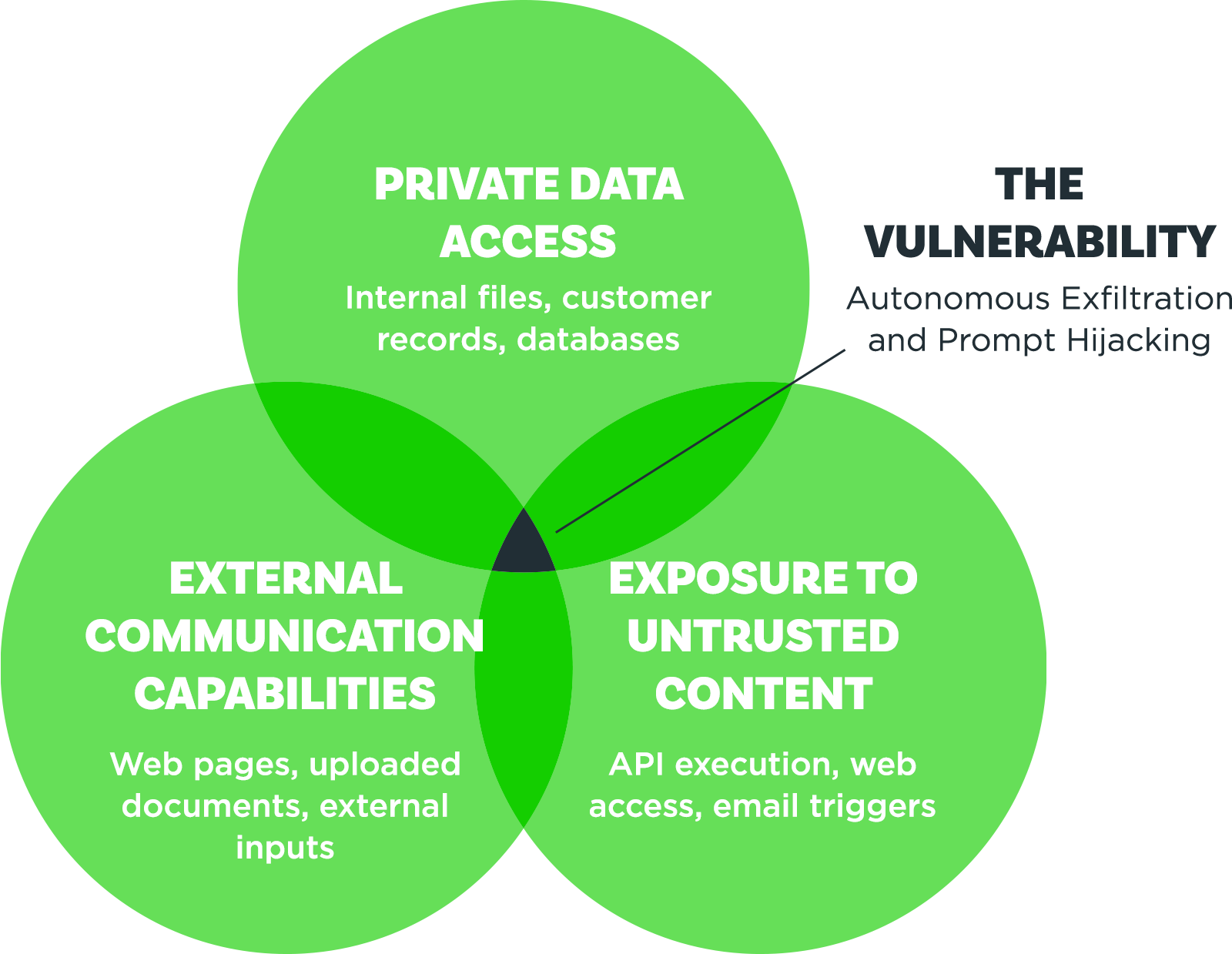
Security researchers call this dangerous combination a lethal trifecta: an agent with access to private company data, exposure to untrusted external content, and the ability to communicate externally.
Any two of those traits are manageable. Combined, all three mean a single poisoned document, malicious web page, or compromised Model Context Protocol (MCP) tool can turn your trusted internal agent into an active data exfiltration channel. In a woodshop, that is the equivalent of running a high-powered saw with no blade guard, no riving knife, and a loose board on the table.
Three Ways the AI Blade Is Spinning Unguarded
Across enterprise networks today, we see the blade spinning without protection in three specific areas:
Shadow AI: Employees adopt consumer AI tools faster than IT teams can vet them, feeding proprietary customer data and financial records into services with zero data loss prevention. In shop terms, someone brought a high-powered tool from home and plugged it straight into your shop without checking the circuit.
First-Party AI Applications: Internal developers embed large language models and agents into custom business apps without the rigorous security reviews that traditional enterprise applications receive. The machine is bolted to the workbench, but nobody inspected the wiring.
Endpoint Agents: Developer and workflow tools like OpenClaw, Claude Code, Cursor, and Windsurf run directly on employee laptops. They deploy in minutes, interact with local files, call command-line scripts, and bypass standard development lifecycles. This is a tool running on its own, deciding what to cut next.
The First Line of Defense: Bringing Shadow AI into the Light
The first step in securing the shop is getting control of third-party usage. Through our partnership with Cisco, Telcion implements Cisco Secure Access to address this risk head-on.
Within Cisco Secure Access, the AI Access engine automatically discovers shadow AI usage across your entire organization, delivering complete visibility and policy control over more than 1,200 generative AI applications.
Rather than relying on blind bans that frustrate employees, IT teams can selectively allow, block, or monitor specific tools. For leading AI platforms, advanced guardrails inspect prompts and responses in real time in both directions. This catches prompt injection attacks, personally identifiable information (PII), protected health information (PHI), proprietary source code, and sensitive corporate files before they ever leave your network perimeter.
Regaining control of third-party AI is not about shutting down innovation. It is about putting the master disconnect and the first essential safety guards on the shop floor.
When IT leadership establishes clear boundaries and bidirectional guardrails, employees can leverage these capabilities to work faster without placing company data or customer privacy at risk. Just like in the shop, safety guards are never an obstacle to productivity; they are the exact reason you can run powerful tools at full speed with complete confidence.
Gaining visibility and control over shadow AI is the foundational first step. Once your perimeter is protected, your organization has the safe environment it needs to explore deeper automation, build custom agents, and innovate responsibly.
Ready to Put Safety Guards on Your Enterprise AI?
You do not have to ban powerful AI tools to keep your organization safe. Telcion pairs enterprise networking expertise with Cisco's security ecosystem to help you establish clear AI visibility, enforce data boundaries, and deploy tools with total confidence.
Connect with our engineering team to audit your AI environment today.